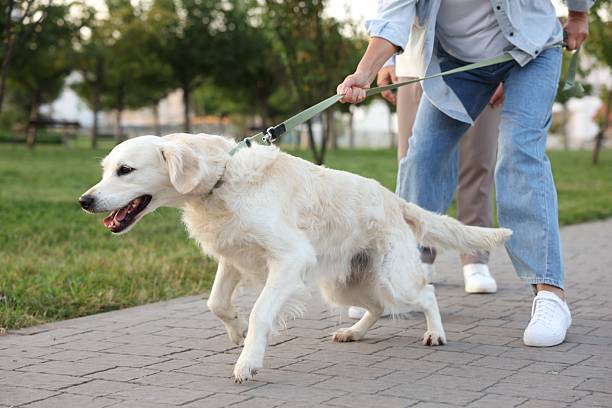
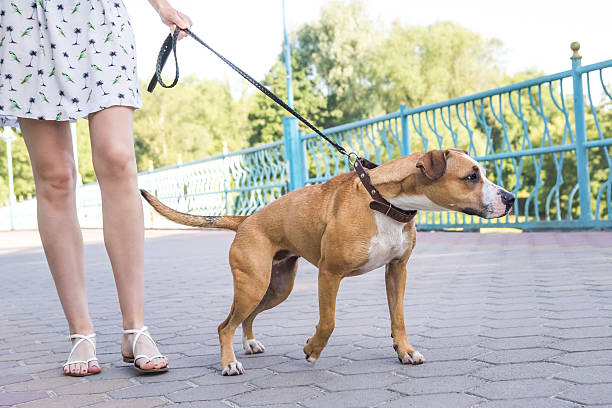
Does your dog turn every walk into a game of tug-of-war?
You step outside, and suddenly your dog is pulling toward a tree, dragging you toward another dog, or racing ahead as if they’re late for an important appointment.
You’re not alone.
Leash pulling is one of the most common challenges dog owners face, especially when a dog is excited by new smells, people, animals, or interesting places.
The good news is that pulling isn’t something your dog has to do forever.
With consistent training and the right approach, you can teach your dog that walking calmly beside you is rewarding.
In this guide, you’ll learn how to train a dog not to pull on the leash, including what equipment to use, how to start training at home, what to do when your dog pulls, and the mistakes that can slow your progress.
Why Do Dogs Pull on the Leash?
Before trying to stop leash pulling, it helps to understand why dogs do it.
Dogs experience the world largely through their noses. A walk isn’t simply exercise for them—it’s an opportunity to investigate smells, sounds, people, animals, and their surroundings.
When your dog sees something interesting, they may naturally want to move toward it.
There is also a simple learning principle involved.
If your dog pulls and you continue walking forward, your dog may learn:
“Pulling gets me where I want to go.”
That means pulling can become self-rewarding.
The goal of leash training is to teach your dog a different lesson:
Walking calmly gets me good things and lets me continue exploring.
What You’ll Need for Leash Training
You don’t need a huge collection of equipment.
Start with:
- A properly fitted collar or harness
- A standard leash
- Small, high-value treats
- A treat pouch
- A quiet training area
- Plenty of patience
Avoid using equipment that causes pain or fear.
If you’re unsure which collar or harness is appropriate for your dog, ask your veterinarian or a qualified, reward-based trainer for guidance.
The most important piece of equipment is ultimately consistency.
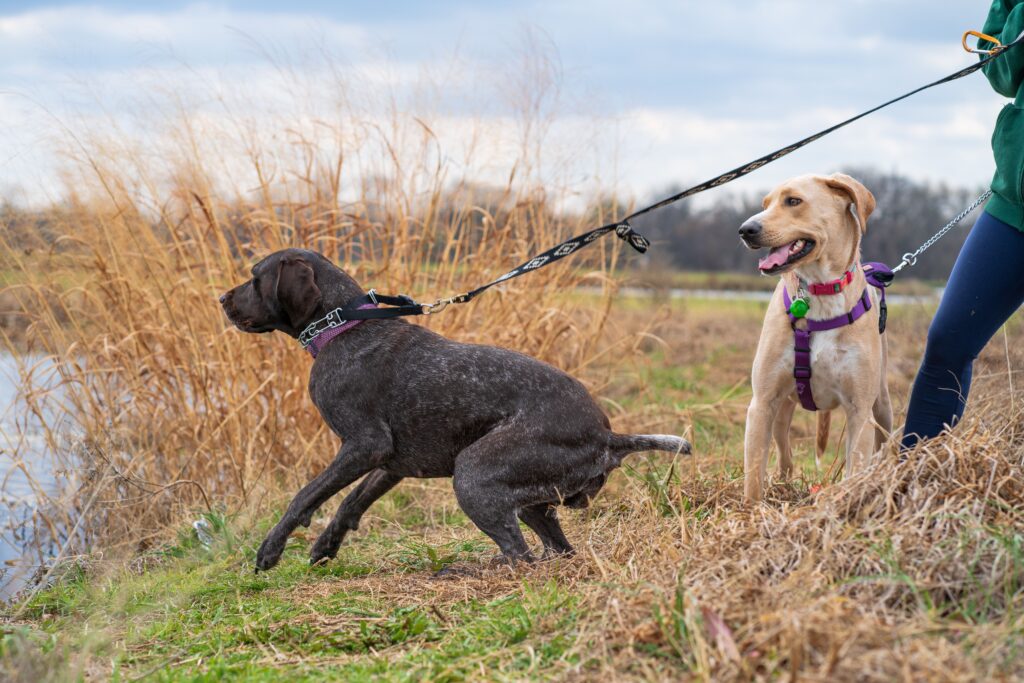
These are 9 steps. How to train a dog not to pull on the leash
Step 1: Start Training Indoors
Don’t immediately begin training on a busy sidewalk.
Your dog has enough distractions outdoors without adding a brand-new skill.
Start inside your home.
Put on the leash and allow your dog to walk around with you.
When your dog voluntarily looks at you or walks near you, reward them.
You aren’t trying to achieve a perfect heel yet.
You’re simply teaching your dog:
Being near my owner is rewarding.
Practice for a few minutes at a time.
Step 2: Teach Your Dog to Pay Attention to You
Attention is one of the foundations of successful leash training.
Stand near your dog.
Say their name.
When they look at you, immediately reward them.
Repeat several times.
You can eventually add a cue such as “watch me” if you want to teach your dog to deliberately focus on you.
This skill becomes particularly useful outside when your dog notices something exciting.
Instead of immediately pulling toward the distraction, you can ask for their attention and reward them for responding.
Related reading: If you’re building your dog’s overall obedience skills, see our complete guide to [Dog Training: The Complete Beginner’s Guide] for more foundational training techniques.
Step 3: Reward a Loose Leash
A loose leash doesn’t mean your dog has to walk directly beside your leg every second.
For normal walks, the goal is usually a leash that isn’t constantly tight.
Take a few steps.
If the leash remains loose, reward your dog.
Then continue walking.
Repeat.
At first, you might only get a few successful steps.
That’s okay.
You’re building a habit.
As your dog improves, gradually increase the number of steps between rewards.
Step 4: Stop When Your Dog Pulls
This is one of the most important parts of leash training.
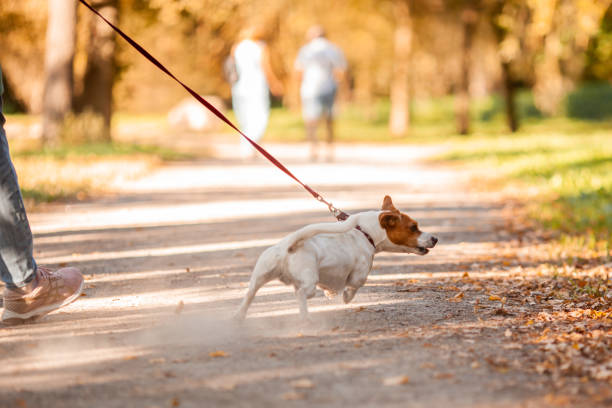
If your dog pulls and you continue moving forward, they may learn that pulling works.
Instead, stop.
Wait for the leash to become loose or for your dog to turn their attention back toward you.
Then continue walking.
You don’t need to yank the leash backward.
The lesson is simply:
Tight leash = we stop.
Loose leash = we move forward.
Consistency matters enormously here.
If pulling works sometimes but not others, your dog may keep trying because the behavior occasionally pays off.
Step 5: Reward Your Dog for Choosing You
Don’t wait until your dog pulls.
Reward the behavior you actually want.
If your dog looks at you during a walk, give them a treat.
If they walk beside you voluntarily, praise them.
If they slow down when you slow down, reward them.
If they ignore a distraction and stay focused on you, that’s worth celebrating.
You’re teaching your dog that good leash manners are valuable.
Over time, you can gradually reduce how frequently you give treats and rely more on praise, play, or the opportunity to continue exploring.
Step 6: Use Direction Changes
Another useful exercise is changing direction when your dog moves too far ahead.
Walk in one direction.
When your dog starts pulling ahead, calmly turn and walk the opposite way.
When your dog follows you, reward them.
This teaches your dog to pay attention to where you’re going instead of automatically deciding where the walk should go.
Practice this in a safe area with plenty of space.
Avoid sudden movements that could cause your dog to become frightened or physically uncomfortable.
Step 7: Increase Distractions Gradually
One of the biggest mistakes owners make is moving from a quiet living room directly to a crowded park.
That’s a huge jump in difficulty.
Instead, progress gradually.
Level 1: Inside your home
Practice basic leash skills without distractions.
Level 2: Yard or quiet outdoor area
Introduce outdoor smells and sounds.
Level 3: Quiet neighborhood
Practice short walks with mild distractions.
Level 4: Busier areas
Gradually introduce more people, dogs, traffic, and environmental distractions.
If your dog starts pulling constantly, you’ve probably increased the difficulty too quickly.
Go back to an easier environment and build up again.
Step 8: Let Your Dog Sniff
Remember that walking isn’t just about getting from Point A to Point B.
For dogs, sniffing is a major part of experiencing their environment.
Instead of constantly preventing your dog from stopping, build sniffing opportunities into your walks.
You might have a few minutes of structured walking followed by a short “sniff break.”
This can make walks more rewarding without allowing constant leash pulling.
You can even use sniffing as a reward.
For example:
Walk calmly → reach interesting area → permission to sniff.
That teaches your dog that calm leash behavior can lead to opportunities they enjoy.
Step 9: Keep Walks Short at First
If your dog has spent months pulling on the leash, don’t expect a perfect 45-minute walk immediately.
Start small.
A five- or ten-minute training walk may be more productive than a long walk filled with frustration.
Focus on quality rather than distance.
As your dog becomes better at walking calmly, gradually increase the duration.
What If Your Dog Pulls Toward Other Dogs?
This can be more complicated.
Some dogs pull because they’re excited and want to say hello.
Others may pull because they’re nervous, fearful, frustrated, or reactive.
Don’t assume every dog pulling toward another dog is simply being friendly.
If your dog becomes highly aroused, barks, lunges, growls, or appears frightened, create more distance.
You don’t need to force an interaction.
Work at a distance where your dog can still pay attention to you.
Reward calm behavior and gradually build their ability to remain relaxed around distractions.
For serious reactivity or aggression, consider getting help from a qualified behavior professional rather than trying to solve the issue through basic leash training alone.
Common Leash Training Mistakes
1. Expecting Instant Results
Leash manners take practice.
If your dog has been pulling for years, changing the habit won’t happen overnight.
2. Only Training During Walks
You can practice attention, sit, stay, and impulse control at home.
These skills can make outdoor training easier.
3. Using Too Many Words
Dogs don’t automatically understand long explanations.
Keep cues short and consistent.
4. Rewarding Only Perfect Behavior
Your dog doesn’t need to be perfect before earning rewards.
Reward small improvements.
5. Walking Too Far Too Soon
Long walks aren’t necessarily better training sessions.
Short, successful sessions can produce better results.
6. Getting Frustrated
Dogs respond to our emotions.
If you’re becoming frustrated, it’s okay to stop and try again later.
How Long Does It Take to Stop a Dog From Pulling?
There isn’t a fixed timeline.
Some dogs show noticeable improvement within a few weeks, while others need months of consistent practice.
Your dog’s age, temperament, previous habits, environment, and motivation all matter.
The important thing is to look for gradual progress.
Maybe your dog used to pull for the entire walk but now walks calmly for five minutes.
That’s progress.
Build on it.
Puppy Leash Training vs. Adult Dog Leash Training
Puppies may learn quickly but have short attention spans.
Their walks should generally be age-appropriate and focused on building positive experiences.
Adult dogs may have stronger established habits, but that doesn’t mean they’re impossible to train.
In fact, adult dogs can learn excellent leash manners with consistency.
The biggest difference is often not ability but history.
An adult dog that has spent years pulling may need more time to replace the old habit with a new one.
A Simple 7-Day Leash Training Plan
Here’s a basic starting point.
Day 1
Practice your dog’s name and attention indoors.
Day 2
Walk around your home with the leash and reward a loose leash.
Day 3
Practice outside in a quiet area for a few minutes.
Day 4
Introduce gentle direction changes.
Day 5
Take a short neighborhood walk and reward calm behavior.
Day 6
Practice around mild distractions.
Day 7
Review everything you’ve learned and repeat the exercises your dog finds most difficult.
Don’t worry about completing the entire plan perfectly.
If your dog needs three days to master something that was scheduled for one day, take three days.
Training isn’t a race.
Frequently Asked Questions
How do I stop my dog from pulling immediately?
There isn’t a guaranteed instant solution. Start by stopping forward movement when the leash becomes tight and reward your dog when they return to a loose leash.
Should I use treats when leash training?
Treats can be very useful, especially when teaching a new behavior. As your dog becomes more reliable, you can gradually vary the rewards.
Is it better to use a collar or harness?
It depends on the individual dog. A properly fitted harness may be useful for some dogs, while others may do well with a collar. If you’re unsure, consult a veterinarian or qualified trainer.
Should I let my dog sniff during walks?
Yes. Sniffing is a natural and enriching behavior. You can incorporate planned sniff breaks while still teaching your dog to walk calmly.
What if my dog pulls harder when I stop?
Give your dog time to learn the new rule. You can also practice loose-leash walking in a quieter environment where your dog has fewer distractions.
Can an older dog learn not to pull?
Absolutely. Older dogs can learn new leash skills. Consistency and gradual practice are key.
Final Thoughts
Learning how to train a dog not to pull on the leash takes patience, but it doesn’t have to be frustrating.
Your goal isn’t to force your dog to walk like a robot.
You want your dog to understand that walking calmly with you is rewarding and that pulling doesn’t get them where they want to go faster.
Start somewhere quiet. Keep sessions short. Reward small improvements. Gradually increase distractions, and give your dog opportunities to sniff and explore appropriately.
Most importantly, stay consistent.
A few minutes of positive practice every day can eventually transform your walks from a constant tug-of-war into something you and your dog genuinely enjoy.
Related reading: If you’re building your dog’s overall obedience skills, see our complete guide to [Dog Training: The Complete Beginner’s Guide] for more foundational training techniques.